Information about 3 endangered animals
1) BENGAL TIGER
Scientific name: Panthera tigris
common name: Tiger
______________________________
**********************************************************************************************************
Scientific name: Panthera tigris
common name: Tiger
Height: 90 – 110 cm (At the withers)
Mass: Male: 220 kg, Female: 140 kg
Length: Male: 2.7 – 3.1 m, Female: 2.4 – 2.6 m
Did you know: The roar of a Bengal tiger can be heard 2 miles away.
_____________________________
The Bengal tiger is a Panthera tigris tigris population native to the Indian subcontinent.It is threatened by poaching, loss and fragmentation of habitat, and was estimated at comprising fewer than 2,500 individuals by 2011.None of the Tiger Conservation Landscapes within its range is considered large enough to support an effective population of more than 250 adult individuals.India's tiger population was estimated at 1,706–1,909 individuals in 2010. By 2018, the population had increased to an estimated 2,603–3,346 individuals.Around 440 tigers are estimated in Bangladesh, 163–253 tigers in Nepal and 103 tigers in Bhutan.

_______________________________
| Kingdom: | Animalia |
| Phylum: | Chordata |
| Class: | Mammalia |
| Order: | Carnivora |
| Suborder: | Feliformia |
| Family: | Felidae |
| Subfamily: | Pantherinae |
| Genus: | Panthera |
| Species: |
P. tigris
|
| Subspecies: |
P. t. tigris
|
______________________________
2) ASIATIC LIONS
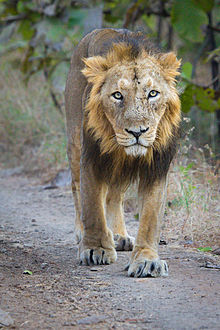
Scientific name: Panthera leo persica
common name: Asiatic lion
______________________________
Scientific name: Panthera leo persica
common name: Asiatic lion
Family: Felidae
Phylum: Chordata
Rank: Subspecies
Did you know: Asiatic lions live in a small family group called a pride.
______________________________
The Asiatic lion is a Panthera leo leo population in India. Its range is restricted to the Gir National Park and environs in the Indian state of Gujarat. On the IUCN Red List, it is listed under its former scientific name Panthera leo persica as Endangered because of its small population size and area of occupancy. The Asiatic lion was first described in 1826 by the Austrian zoologist Johann N. Meyer who named it Felis leo persicus. Until the 19th century, it occurred in Saudi Arabia eastern Turkey, Iran, Mesopotamia, and from east of the Indus River to Bengal and Narmada River in Central India. Since the turn of the 20th century, it is restricted to the Gir Forest National Park and surrounding areas. In May 2015, the 14th Asiatic Lion Census was conducted over an area of about 20,000 km2 (7,700 sq mi); the lion population was estimated at 523 individuals, comprising 109 adult males, 201 adult females and 213 cubs.
_____________________________
| Kingdom: | Animalia |
| Phylum: | Chordata |
| Class: | Mammalia |
| Order: | Carnivora |
| Suborder: | Feliformia |
| Family: | Felidae |
| Subfamily: | Pantherinae |
| Genus: | Panthera |
| Species: |
P. leo
|
| Subspecies: |
P. l. leo
|
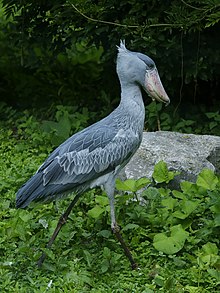
3) Scientific name: Balaeniceps rex
Family: Balaenicipitidae; Bonaparte, 1853
Kingdom: Animalia
Order: Pelecaniformes
Phylum: Chordata
Did you know: It is large and shaped like a shoe, which is the reason why the bird is named "shoebill"
______________________________
The shoebill (Balaeniceps rex) also known as whalehead, whale-headed stork, or shoe-billed stork, is a very large stork-like bird. It derives its name from its enormous shoe-shaped bill. It has a somewhat stork-like overall form and has previously been classified with the storks in the order Ciconiiformes based on this morphology. However, genetic evidence places it with the Pelecaniformes. The adult is mainly grey while the juveniles are browner. It lives in tropical east Africa in large swamps from Sudan to Zambia.
______________________________
| Kingdom: | Animalia |
| Phylum: | Chordata |
| Class: | Aves |
| Order: | Pelecaniformes |
| Family: | Balaenicipitidae Bonaparte, 1853 |
| Genus: | Balaeniceps Gould, 1850 |
| Species: |
B. rex
|

Comments
Post a Comment